Think of Speakers’ Corner and what comes to mind? The spot where Karl Marx stood in 1855 to protest against the Sunday Trading Bill, hoping it would herald the English Revolution? Where the Pankhursts once proclaimed the cause of votes for women? Where Pan-Africanists Marcus Garvey and, later, Walter Rodney, spoke regularly during their time studying in London? Or perhaps as the place George Orwell once claimed hosted “a large variety of plain lunatics”?
In a world where we’re more likely to look to social media for public debate it can nowadays seem strange that London has a physical space, designated by an Act of Parliament, for free speech and the open sharing of views. I think it’s fair to say that in recent years, the famous soapbox is more usually seen as where eccentrics ply their views to passing tourists. Perhaps, as Orwell suggested, it was always so.
Speakers’ Corner is close to the site of the infamous Tyburn Gallows where during the 12th to the 18th Centuries thousands of prisoners were executed before large crowds. The condemned were entitled to make a final speech, sometimes a plea in their own defence, sometimes a criticism of the powers that be – a somewhat gruesome antecedent to what the area later came to be famous for.
By the mid-19th Century, movements such as the Reform League, which campaigned for broader voting rights (at that time, only for men) often met at the north-east corner of Hyde Park. The authorities initially tried to stop them. This led to protests and, eventually, the right to free speech and assembly in Hyde Park was formally recognised in the 1872 Parks Regulation Act.
I, like many others, had thought of Speaker’s Corner as a one-off, in London terms at least (similar spots exist in various countries around the world). But a chance conversation with a family member who has lived in Wood Green for decades led me to discover that such dedicated locations were once a much more common feature of London’s civic life.
From about 1867 until the 1980s, the corner of Wood Green High Road and Lordship Lane was known as Spouter’s Corner, a local version of Speakers’ Corner. A Wetherspoons pub that now occupies the site has adopted the name.
At the peak of their popularity (between the mid-19th Century and the 1930s), there were around 100 “speakers corners” in London, many of them in the capital’s parks, but also in marketplaces and on street corners. There are, for example, spots in Palmers Green and in Victoria Park, where campaigners for women’s suffrage often spoke.
<img decoding="async" data-attachment-id="43633" data-permalink="https://www.onlondon.co.uk/elin-morgan-on-spouters-corner/screenshot-2026-09-25-at-12-13-21/" data-orig-file="https://www.onlondon.co.uk/wp-content/uploads/2026/09/Screenshot-2026-09-25-at-12.13.21.png" data-orig-size="675,497" data-comments-opened="0" data-image-meta="{"aperture":"0","credit":"","camera":"","caption":"","created_timestamp":"0","copyright":"","focal_length":"0","iso":"0","shutter_speed":"0","title":"","orientation":"0","alt":""}" data-image-title="Screenshot 2026 09 25 at 12.13.21" data-image-description data-image-caption="
Screenshot 2026 09 25 at 12.13.21
” data-large-file=”https://www.onlondon.co.uk/wp-content/uploads/2026/09/Screenshot-2026-09-25-at-12.13.21.png” class=”size-full wp-image-43633″ title=”Screenshot 2026 09 25 at 12.13.21″ src=”https://www.onlondon.co.uk/wp-content/uploads/2026/09/Screenshot-2026-09-25-at-12.13.21.png” alt=”Screenshot 2026 09 25 at 12.13.21″ width=”675″ height=”497″ srcset=”https://www.onlondon.co.uk/wp-content/uploads/2026/09/Screenshot-2026-09-25-at-12.13.21.png 675w, https://www.onlondon.co.uk/wp-content/uploads/2026/09/Screenshot-2026-09-25-at-12.13.21-300×221.png 300w, https://www.onlondon.co.uk/wp-content/uploads/2026/09/Screenshot-2026-09-25-at-12.13.21-600×442.png 600w” sizes=”(max-width: 675px) 100vw, 675px”>
Over time, these other “speakers’ corners” and their role in society faded from view as people turned elsewhere, initially to radio and then television, for political debate and the sharing of views. Nonetheless, Spouter’s Corner continued to operate through the 1960s and 1970s, with anti-racism campaigners and speakers from the Campaign for Nuclear Disarmament among the regular attenders.
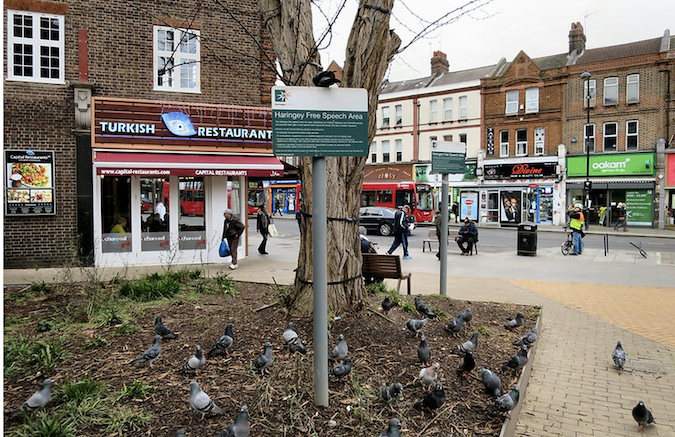
When Wood Green was redeveloped in the 1980s and the original Spouter’s Corner given over to other uses, the council designated an alternative spot outside the library across the road and named it the Haringey Free Speech Area. My family recall it being active until quite recently, with speakers hailing Saturday shoppers about issues including the David Cameron government’s austerity measures, Brexit and politics in the Middle East, along with religious preachers.
One sunny afternoon in July, I took the 123 bus from near my home to seek it out. It wasn’t apparent on the day of my visit, but Haringey has a storied history of political dissent and activism. As it rounds the corner from Turnpike Lane tube, the 123 passes the iron gates of Duckett’s Common, where in 1987, 3,500 protesters met for the “Smash the Backlash march” in opposition to racism and discrimination, in the context of Margaret Thatcher’s proposed Section 28, which proscribed the “promotion of homosexuality” in schools. It was one of the earliest recorded demonstrations against the legislation and is commemorated on the nearby Roundway with a plaque.
Wood Green was busy with people ducking in and out of local shops, as well as the mall that dominates the town centre. Groups sat outside cafés chatting over coffee and cigarettes. At the Spouter’s Corner Wetherspoons I heard no speeches, though lively discourse was taking place over Sunday lunch at several tables.
Illustrated boards are placed on the walls to inform drinkers of the history of the site and the source of its unusual name. But the former “free speech” area outside the library was quiet. and there was nothing to see there except people sitting pensively on benches and a few pigeons. The green sign I’ve seen online (photo above) that marks the spot is no longer there.
In 2023, Haringey Council consulted with local residents on plans for the future of Wood Green. The suggestions included “Improving the ‘free speech’ area to make it more conversational and varied”. It was an interesting idea, but it seems to have fallen by the wayside. A spokesperson for the council said, “As things stand there are no active plans right now to have a designated Wood Green Free Speech area, but it remains an aspiration.”
In recent years, free speech has become a freighted term, often co-opted and weaponised by those on the far-Right in particular. We’ve seen what happened to Twitter as it became X after Elon Musk took over, promising to restore free speech to the platform.
In light of the toxicity of so much current political discourse, I’ve started to wonder if there might be a role for 21st Century versions of the speakers’ corners that once existed in local communities, offering a space where people of varied or even opposing views can meet one another as human beings, without the shield of keyboard and screen. Perhaps it’s an idealistic plan, but I’d be up for giving it a try.
Elin Morgan is a writer and communications professional from east London. Follow her on Bluesky. Photo showing site of Spouters’ Corner courtesy Alan Stanton via Flickr.
OnLondon.co.uk is funded by sales of publisher and editor Dave Hill’s twice-weekly newsletter On London Extra. To start receiving it, become a paying subscriber to Dave’s personal Substack. Thanks.